Case studies

Understanding the “why” of coding and documentation
Christopher Beney, MD, didn’t go to school for coding. With years of experience serving on local hospital boards, Dr. Beney saw firsthand “how woefully underdiagnosed patients can be.” Having the Vatica program saves him a tremendous about of time. “Accurate coding and documentation is a means to ensure that the appropriate amount of resources go to each patient. It benefits everyone to show the full complexity of a patient’s burden of illness. The process helps patients, providers and insurers,” he says.
Case study
Relieve the burden of coding and documentation
Provider members of the Kentucky Primary Care Clinically Integrated Network found support in the Vatica program at no cost. Vatica relieved the burden of coding and documentation while generating additional health plan compensation. Read our case study for the noteworthy results.
Relieve the burden of coding and documentation with Vatica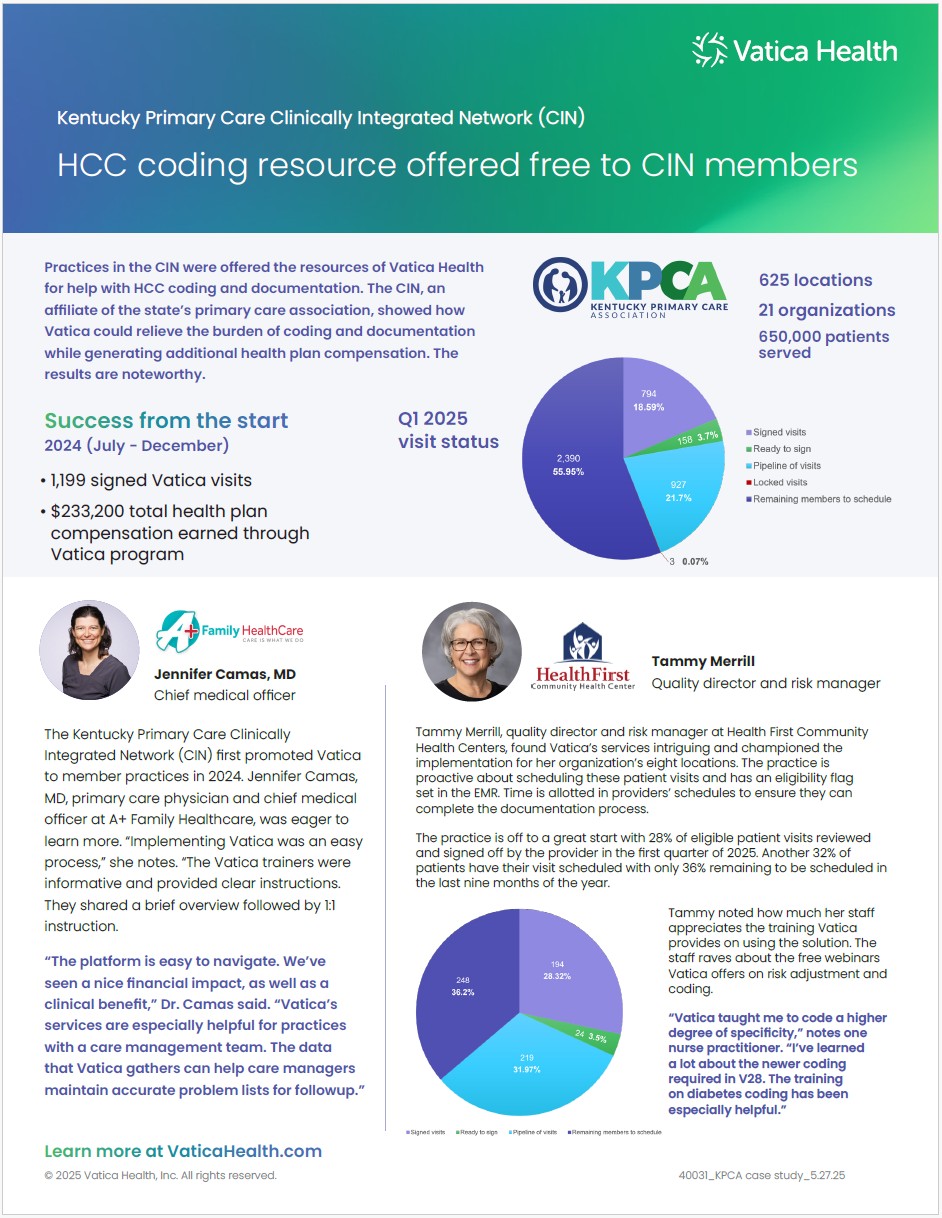
Resources
Read our latest thoughts
on healthcare

Subscribe to Vatica Voice
Get our latest news and insights delivered directly to you.
Adjust your approach to risk adjustment
Talk to one of our risk adjustment experts today to see how we can help you deliver better performance and stronger compliance while closing gaps in care.