Blog

July 16, 2026
Healthcare’s problem isn’t the system, it’s us
A fireside chat with Sachin Jain, MD, at Cozeva’s 2026 User Group Meeting
Every year, Cozeva brings together a national community of healthcare leaders for an honest conversation about where healthcare stands and what it will take to move forward. Sachin Jain, MD, MBA, CEO of SCAN Group and SCAN Health Plan, opened the conversation this year with SCAN’s “Health Insurance is Broken” ad campaign. The award-winning campaign shows the frustrations patients live with every day, from unexpected prescription costs to delays in care and confusion over coverage details.
In each of his three decades in healthcare, Jain has faced a different “boogeyman,” from the quality crisis to coverage expansion, to today’s push toward value-based care. Each time, the industry implemented a fix, yet nothing improved. In some cases, things got worse. Why?
“It’s us,” Jain said. “We’re not necessarily taking charge of the problems that are under our control.”
Toxic positivity isn’t optimism
Last year, as scrutiny of the industry picked up, Jain saw a pattern he calls “toxic positivity.” Rather than sitting with the very real anger over cost, denials and administrative burden, executives simply pointed to the flawed system.
“You can’t fix something until you actually acknowledge it’s a problem,” Jain said. “But if we keep going along saying that we’re wonderful and we’re great and we’re promoting affordability, we’ll never actually get to solving the real problems.”
Blaming something external such as the system, the regulators or the funding, might feel safer in the moment. But it also means giving up any real ability to fix it.
“No one’s buying it anymore,” he said.
The crisis hiding in plain sight
Jain described what he called a “crisis of leadership” in healthcare. Leaders, he argued, need to focus on long-term goals, even when that means taking actions against their own interests because there is a bigger one at stake.
He described a recent conversation he had with the chief of cardiology at a Northeast academic medical center who had built a successful heart failure management program that keeps patients out of the hospital. The hospital’s response? A call asking what the department was doing wrong since admissions had dropped. When the physician explained the program was working and they were taking care of patients, he was told: No margin, no mission.
That phrase, Jain argued, has become a cover for exactly the kind of leadership failure he was describing. A nonprofit institution chartered to keep people healthy, measuring success by how many sick people walk through the door and silencing the clinicians who point out the contradiction.
“We have so much more latent leadership capacity in this industry than we’re exercising,” Jain said. “We have so many people with so much ingenuity, creativity, drive and passion, and we kill it.”
According to Jain, the number one way to make healthcare better is to tap leaders that genuinely support, enable and desire an improved healthcare system.
Courageous challenge
At SCAN, Jain has made “courageous challenge” one of the organization’s core values, which gives employees permission to stand up and say something that goes against the grain of the organizational culture.
The goal isn’t to manufacture dissent, but to create an environment where it’s okay to have difficult conversations, to challenge our own status quo and encourage people to ask hard questions.
Accountability in action
Jain shared that every quarter he sends his personal work email address to each of SCAN’s 440,000 members. He generally receives three types of messages every day: one from a member who is happy, one who gives helpful advice and one who is angry.
For him, accountability requires being close to your customers and willing to apologize when needed.
“We don’t do that enough,” Jain said. “We hide behind HIPAA, we hide behind the ACA, we hide behind whatever rules we think we can hide behind. We hide behind our vendor partners.”
The only way to stop normalizing the abnormal is to stop making it easy to look away.
Depth over breadth
Jain saved one of his most practical points for the end: the case for what he called “monogamy in provider-plan relationships.”
Healthcare, he observed, is extraordinarily promiscuous. Providers partner with every plan. Plans partner with every provider group. Everyone maintains maximum optionality. As a result, no one builds anything deep enough to change the patient experience.
In the 2025 Medicare Annual Election Period, SCAN enrolled 127,000 new members, ranking it among the top 10 Medicare Advantage plans nationally. Part of that success came from asking provider partners to stop splitting their membership across every plan and work with SCAN exclusively.
By working together exclusively, the health plan and the provider can make the patient experience feel more like working with a single entity, rather than two disparate systems.
What would it look like, Jain asked, to have a shared call center? A shared patient record? A shared accountability for outcomes? It’s not a utopian vision; it’s a logical consequence of successfully aligning incentives.
That kind of alignment, where both sides work from the same information and share accountability, is what Cozeva + Vatica is built on. The connected ecosystem is payer, line-of-business and EMR agnostic, and becomes part of a provider’s existing workflow. In turn, payers work from a single performance management system spanning quality, risk and medical cost management, giving both sides the same view instead of reconciling after the fact.
This post was inspired by Sachin Jain’s keynote session at Cozeva + Vatica’s 2026 User Group Meeting. Views expressed are his own and are presented here because we think they’re worth carrying into the broader conversation.
Case study
Relieve the burden of coding and documentation
Provider members of the Kentucky Primary Care Clinically Integrated Network found support in the Vatica program at no cost. Vatica relieved the burden of coding and documentation while generating additional health plan compensation. Read our case study for the noteworthy results.
Relieve the burden of coding and documentation with Vatica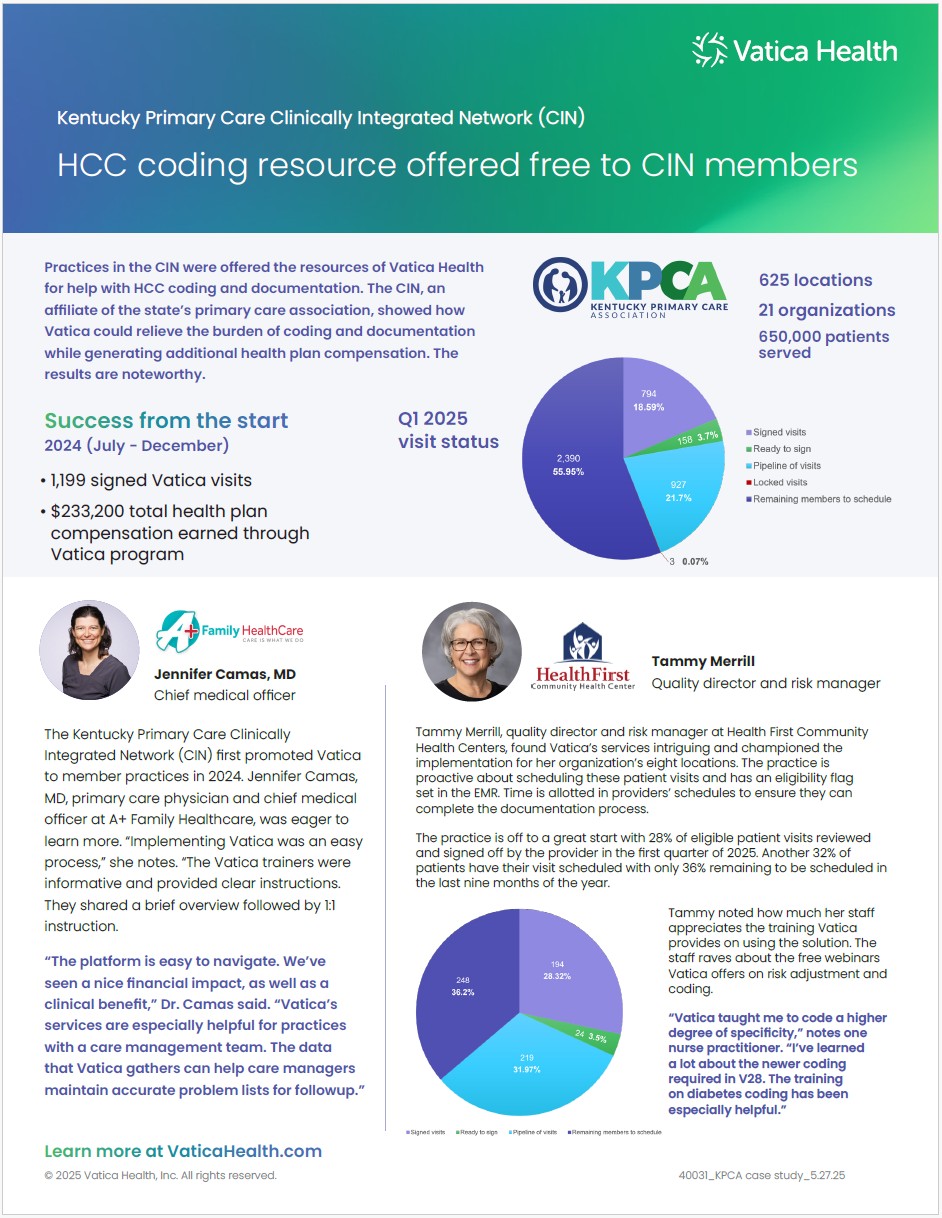
Resources
Read our latest thoughts
on healthcare

Subscribe to Vatica Voice
Get our latest news and insights delivered directly to you.
Adjust your approach to risk adjustment
Talk to one of our risk adjustment experts today to see how we can help you deliver better performance and stronger compliance while closing gaps in care.