Blog

August 24, 2026
What the Clover Health ruling means for Medicare Advantage
How recent litigation is accelerating the evolution of CMS Star Ratings
For years, Medicare Advantage (MA) organizations have viewed the CMS Star Ratings Program as the gold standard for measuring quality, rewarding high-performing plans and improving member outcomes. Star ratings influence billions of dollars in Quality Bonus Payments (QBP), shape benefit design, affect provider incentive programs and help millions of Medicare beneficiaries choose their health plan.
Today, however, the Star Ratings Program is at the center of a legal and regulatory debate with potential implications for the long-term structure of the program.
How we got here
In May 2026, the U.S. District Court for the Southern District of Georgia ruled in favor of Clover Health, finding that CMS had improperly included 20 measures in its 2026 Star rating calculation. Ten measures relied on data sources beyond CMS’s statutory authority, and the other ten were adopted without required notice-and-comment rulemaking.
CMS recalculated Clover’s rating from 3.5 to 4.5 stars and announced a voluntary recalculation of affected 2027 QBP ratings using only authorized data sources, with a “hold harmless” policy so that no organization’s recalculated rating would decrease.
That decision quickly became the catalyst for additional legal action. Elevance Health, SCAN Health Plan and Alignment Healthcare each filed lawsuits seeking the same remedy, citing significant financial impacts if their contracts were recalculated under the same methodology. According to publicly reported filings, the estimated financial implications range from approximately $50 million to $125 million per organization.
CMS is now appealing the original ruling to the Eleventh Circuit.
Why this matters beyond the courtroom
Although headlines have focused on litigation, the larger issue is how the Stars Program is designed and governed – and the downstream effects on health plans, providers, members and vendor partners.
Health plans invest heavily in quality improvement initiatives based on CMS guidance. Providers redesign workflows around Star measures. Technology vendors build solutions aligned to regulatory requirements. Members rely on star ratings to compare health plans.
Underneath all of this, the measures exist to drive better care: preventive screenings, chronic disease management and improved member experience. When the mechanics are contested, the goal can get lost, and that goal is better health outcomes for patients.
Regardless of how the Eleventh Circuit rules, or how CMS revises its approach, that underlying goal doesn’t change. Organizations that build their quality strategy around improving care, not just optimizing the current measure set, will be positioned to succeed no matter how the program evolves.
Changes are already underway. NCQA’s digital HEDIS expansion and CMS’s ongoing interoperability initiatives reinforce the direction toward clinical outcomes and away from administrative process measures.
Five actions Medicare Advantage plans should take now
Rather than viewing this moment as a disruption, organizations should use it as a catalyst to shift from year-end performance recovery toward continuous, prospective risk and quality management, modernizing data infrastructure and deepening provider engagement to create value under any future regulatory framework.
- Strengthen data governance: Ensure HEDIS, CAHPS, HOS, claims and clinical data are accurate, complete and audit-ready.
- Invest in prospective risk and quality management: Identify care opportunities early and proactively address underlying conditions before they’re missed.
- Improve provider engagement: Deliver actionable insights directly within clinical workflows to reduce administrative burden and improve performance.
- Expand scenario planning: Model potential impacts of regulatory and methodology changes on quality scores, reimbursement and provider incentive programs.
- Continue investing in member experience: Regardless of legal outcomes, improving the healthcare experience remains one of the strongest drivers of long-term success.
How Cozeva + Vatica supports a more resilient quality strategy
At Cozeva + Vatica, we built our platform around a simple premise: quality improvement works best when it happens continuously, not at year end.
Our platform helps payers and providers:
- Surface insights during the visit, so the right action happens at the point of care rather than post-visit outreach.
- Unify disparate data sources into a single complete view of each member to deliver measurable outcomes.
- Reduce administrative burden by replacing manual workflows with processes that generate quality data as a byproduct of good care.
This combination strengthens HEDIS, Stars and risk adjustment accuracy, but more importantly it means members get preventive care and chronic disease management while it still matters clinically. That’s the outcome regulatory frameworks are ultimately trying to protect, and it’s the one that holds up no matter how the Clover Health litigation resolves or how CMS restructures its program going forward.
Case study
Relieve the burden of coding and documentation
Provider members of the Kentucky Primary Care Clinically Integrated Network found support in the Vatica program at no cost. Vatica relieved the burden of coding and documentation while generating additional health plan compensation. Read our case study for the noteworthy results.
Relieve the burden of coding and documentation with Vatica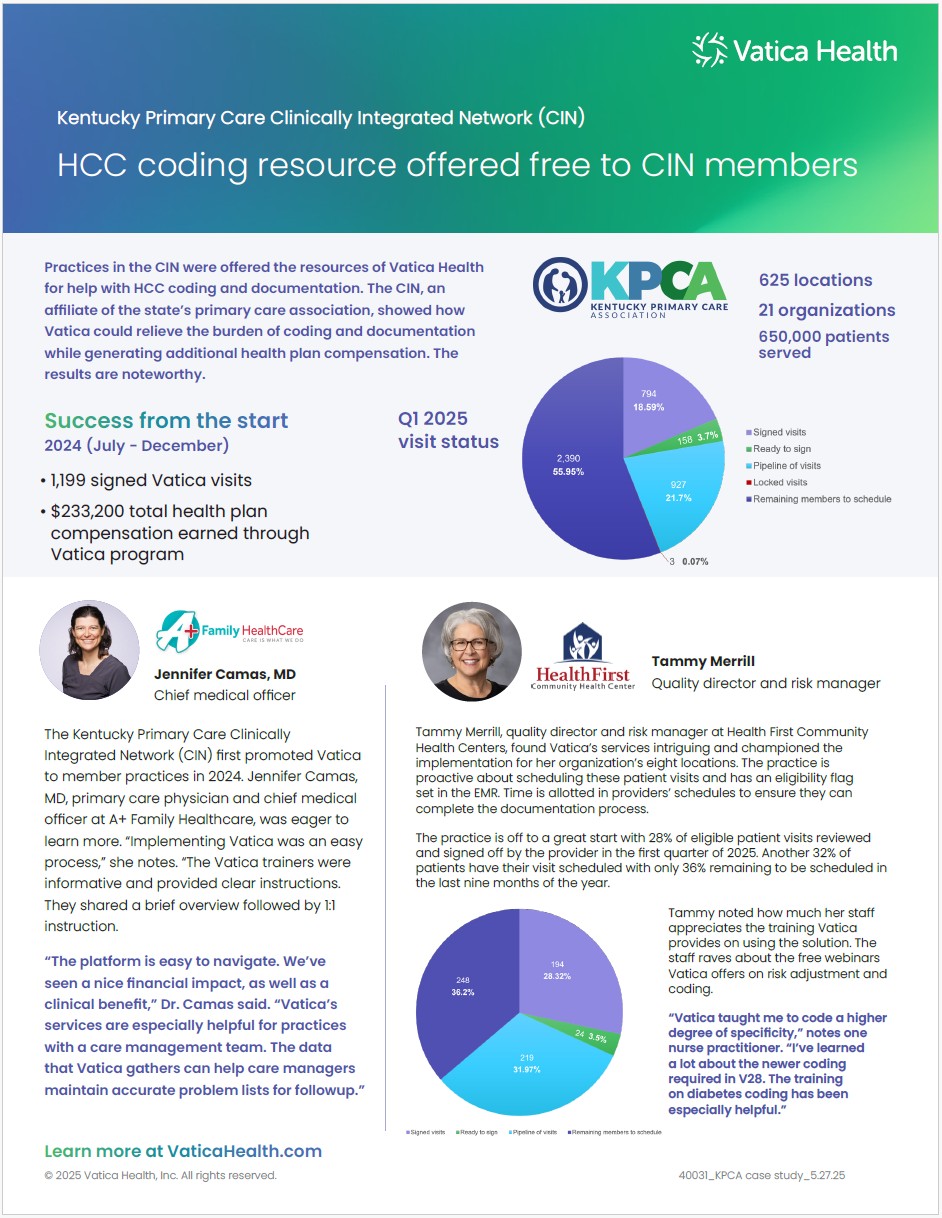
Resources
Read our latest thoughts
on healthcare

Subscribe to Vatica Voice
Get our latest news and insights delivered directly to you.
Adjust your approach to risk adjustment
Talk to one of our risk adjustment experts today to see how we can help you deliver better performance and stronger compliance while closing gaps in care.